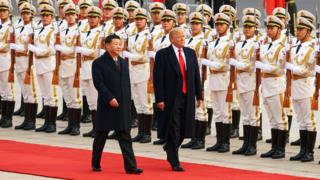
 picture copyright Getty photos photo caption the two presidents preside over markedly different countrywide economic models
A US-China trade deal - if it happens - is unlikely to conclusion the contention between both financial giants.
each side have fought a trade struggle over the last 12 months with damaging consequences for the international economic climate.
however many say their dispute goes well beyond exchange - it represents a power-combat between two very distinct world views.
Deal or no deal, that competition is barely anticipated to broaden and become more difficult to get to the bottom of.
"we have entered into a new regular during which US-China geopolitical competition has intensified and turn into more specific," says Michael Hirson, Asia director at consultancy firm Eurasia group.
"The change deal will average one section of the USA-China vigor fight, but only briefly and with restrained impact."
the united states-China competition is likely to play out next in the vital technology sector, analysts say, as each side are attempting to set up themselves because the world's expertise leader.
concerns round expertise switch were key during trade talks between the realm's two greatest economies in fresh months.
"each nation now accurately recognises that their prosperity, their wealth, their economic security, their armed forces security goes to be linked to conserving a technological aspect," says Stephen Olson, research fellow at international alternate advisory physique Hinrich basis.
The know-how fightMany say the us-China know-how battle is already below approach - and China's tech enormous Huawei is at its very centre.
Huawei has been the center of attention of severe foreign scrutiny currently, with the us and other international locations raising protection considerations about its items.
the U.S. has restricted federal companies from using Huawei products and has inspired allies to shun them.
Australia and New Zealand have each blocked using Huawei gear in subsequent-generation 5G cellular networks.
picture copyright Getty pictures graphic caption the united states government has accused Huawei of being a spying chance, some thing it strongly denieshowever Huawei has referred to it is impartial from the chinese language government. Its founder Ren Zhengfei told the BBC in February that his company would by no means undertake any spying activities.
The dispute reached fever pitch with the arrest of the founder's daughter in December, and more recently Huawei's lawsuit against the U.S. executive.
Huawei has also long past on a public family members offensive, putting a full-page advert within the Wall street Journal telling americans no longer to "trust everything you hear".
"The term 'cold battle' is overused within the context of typical US-China tensions, but is more and more accurate in describing their technology competitors," says Mr Hirson.
The dispute over Huawei is "symptomatic of this intensified geopolitical competitors," he provides.
"This competition is way more complicated to unravel than pure change considerations."
How did we get here?US issues about China have grown in contemporary years, along with China's influence around the globe.
Its massive Belt and road Initiative, the Made in China 2025 plans, and the becoming magnitude of corporations like Huawei and Alibaba have all contributed to those fears.
US vice president Mike Pence summed up the temper in a speech in October, saying China had chosen "financial aggression", in place of "more suitable partnership" because it opened its economic system.
Hopes China would embody a more Western mannequin has given approach to a cognizance that China's financial system has boomed alongside a state-run gadget, now not even with it.
"China has become a whole lot greater express in its ambitions in the closing few years," says Andrew Gilholm, director of evaluation for China, at consultancy handle risks.
"for this reason nobody is imagining that China goes to follow a Western liberal democratic model, or converge towards a market financial system within the approach that americans hoped a couple of years ago."
photo copyright Getty images picture caption China's exports have boomed over the last two many yearsSome analysts believe a stand-off between both aspects became inevitable.
Their distinct programs have all the time made them awkward bedfellows in the international financial system, while clashes between latest and rising powers are commonplace in background.
"What we're dealing with here is friction between typical free market economics, free alternate economics, Washington consensus concepts versus - for the primary time - a massive, technologically refined, centrally-managed economy it's taking part in the online game through a different set of guidelines," says Mr Olson.
What happens now?because the expertise race gathers tempo, analysts are expecting the U.S. to continue to use non-tariff measures to push again against China.
Restrictions on chinese funding into the us, limits on the capacity of US corporations to export know-how to China, and extra force on chinese language corporations are all tools that could be used, they say.
"Non-tariff measures do not get the consideration from markets that tariffs do, partly as a result of their have an effect on is tougher to quantify, but they could have some distance-achieving impact," says Mr Hirson.
world alternategreater from the BBC's series taking a global standpoint on exchange:
a brand new US legislations passed final year might facilitate this push-returned.
It reinforced the executive's energy to overview - and potentially block - company offers involving overseas companies via expanding the category of deals that can be reviewed by way of the Committee on foreign investment within the US (CFIUS).
The committee vets international investments to see in the event that they pose a possibility to countrywide security.
remaining 12 months, even before the brand new legislations passed, a excessive-profile deal involving the sale of US-based mostly cash switch firm MoneyGram to Alibaba's digital funds arm Ant fiscal collapsed when the businesses did not get the mandatory approval from CFIUS.
New US-China norm?How US-China relations enhance from right here will partly rely on the variety of change deal they strike.
burdened by means of tit-for-tat tariffs, both sides have shown a willingness to speak since agreeing on a truce in December.
image copyright Getty images graphic caption President Trump has been talked tough in opposition t China over the exchange difficultybut analysts say the connection between the two giants might seem distinct going forward no matter any change deal.
They could have "a completely cooperative, flourishing, at the same time a good option relationship" in definite areas however put up barriers in others in what Mr Olson described as a "selective decoupling".
An expanding variety of areas may well be fenced off, mainly those concerning know-how, he says.
"Is Huawei ever going to, in a significant approach, be in a position to take part within the construction of the 5G network within the u.s.? It seems unlikely."


0 comentários:
Postar um comentário