 magnify Chris Potter reader feedback 251 with 59 posters taking part, together with story writer Share this story
regardless of what the realm's least-unique speakme gecko would have you accept as true with, no one likes handing over payments for car assurance. however there's one issue everybody likes even much less: suddenly purchasing costly repairs no longer lined through your assurance.
similarly, opponents of motion on climate alternate want to complain concerning the prices of doing away with fossil fuel emissions. customarily, this suggests that the alternative—ignoring climate exchange—is free. It isn't.
a new analyze by means of Jeremy Martinich and Allison Crimmins of the U.S. Environmental protection company provides probably the most distinctive estimate yet of the economic expenses of local weather trade within the united states. They found that taking motion to cut back emissions might save us as a minimum $200 billion per year by the end of the century.
extra reading State-by way of-state climate analysis suggests warming hits some harder than othersthe hassle comprises using models to simulate the methods distinctive economic sectors are affected by local weather alternate and the way these results ripple from one sector into others. A great 2016 analyze used previous relationships between temperature and economic undertaking to challenge the impact of warming on six economic sectors in the US, drilling all the way down to the county degree. This new analyze tries to extend that to 22 sectors and relies much less on mathematical relationships from the past to mission to the new climates of the future.
The 22 sectors consist of fisheries, electrical technology, coastal property, roads, detrimental algal blooms, air high-quality, and others. each became analyzed with the effects of 5 diverse local weather fashions simulating two eventualities: a high-greenhouse-gasoline-emissions "enterprise-as-normal" state of affairs that warms the area round four.5°C (eight°F) by means of the end of this century and an intermediate emissions situation that outcomes in about 2.5°C warming (4.5°F).
every thing was analyzed for the reduce forty eight states, while particulars on Alaska, Hawaii, and Puerto Rico were limited.
The mannequin results exhibit that either greenhouse fuel emissions scenario could be expensive. in the excessive-emissions scenario, the calculated economic damages introduced as much as about $500 billion per 12 months by using 2090. that is due to things like misplaced labor and untimely deaths caused through changes in temperature extremes and air pollutants, loss of infrastructure damaged by means of flooding, and even activity and tourism losses from disappearing coral reefs, declining snowpack, and hazardous algal blooms.
The researchers describe these estimates as conservative, for the reason that a confined set of influences are covered. "as an example," they write, "the wildfire evaluation captures only suppression charges, and does not estimate fitness impacts from degraded air or water quality, property harm, or timber loss."
As in old stories, there are huge ameliorations between the damages in different areas of the U.S.. The affect of extremely sizzling weather, flooding, and West Nile virus, for instance, are enormously improved in southern states. The loss of tourism salary as coral reefs disappear is surely a bit extra critical in Hawaii than Oklahoma. And coastal property is more threatened in low-lying Florida than in Alaska, the place geologic recreation is raising land elevations alongside the coast.
but there are adequate factors covered right here that complications in one area are usually balanced through different influences in others. if you compare per-person affects, the regions definitely come out pretty shut.
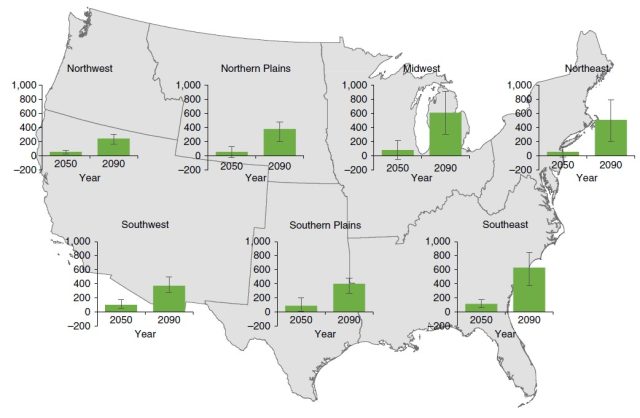 amplify / The calculated per capita value of reducing emissions, in terms of financial damages prevented. Martinich & Crimmins/Nature local weather trade
 via comparing the estimated damages within the lower and higher emissions scenarios, you could see the economic value of actions that cut emissions. The change between the two eventualities, in this case, is a cool $220 billion per yr through 2090 for the us as an entire. That's how much economic harm is averted by using guidance toward one future in place of the other—even within the low emissions scenario, there are nonetheless $280 billion per year in damages you didn't evade. (Free lunches are off the table, but the entrees provided include varying degrees of meals poisoning.)
Mitigating climate impacts via limiting warming isn't the only device attainable—we will also adapt to changes as they arrive, lessening the damage they do. The examine also verified some selected adaptation scenarios for a number of sectors. This includes strengthening and protecting infrastructure from things like sea-level upward push; one other example checked out here involves the management of railroads throughout hot weather. At excessive temperatures, trains must slow down because the tracks can buckle as they extend. with the aid of investing in a community of sensors to video display rail situations, rail companies could evade unnecessary delays.
The researchers ran situations without any adaptation or mitigation, with simply adaptation, and with each. Damages were smallest when both concepts were employed, which shouldn't be amazing. however for the examples they analyzed, the adaptations made a huge difference. hurt to coastal property, as an instance, debts for $one hundred twenty billion by means of 2090 within the excessive-emissions state of affairs and nonetheless costs $ninety two billion within the lower-emissions situation. but add in adaptation and that cost drops to $5.7 billion per yr.
whereas adaptation and mitigation comes with a cost tag, you'd must be aware of the charge of state of being inactive to determine the quantity that would basically be lost out of your future checking account. while financial analyses frequently must assign financial cost to things like untimely deaths, most individuals will argue there is additionally some non-financial price lacking from the ledger.
Nature climate alternate, 2019. DOI: 10.1038/s41558-019-0444-6 (About DOIs).


0 comentários:
Postar um comentário